
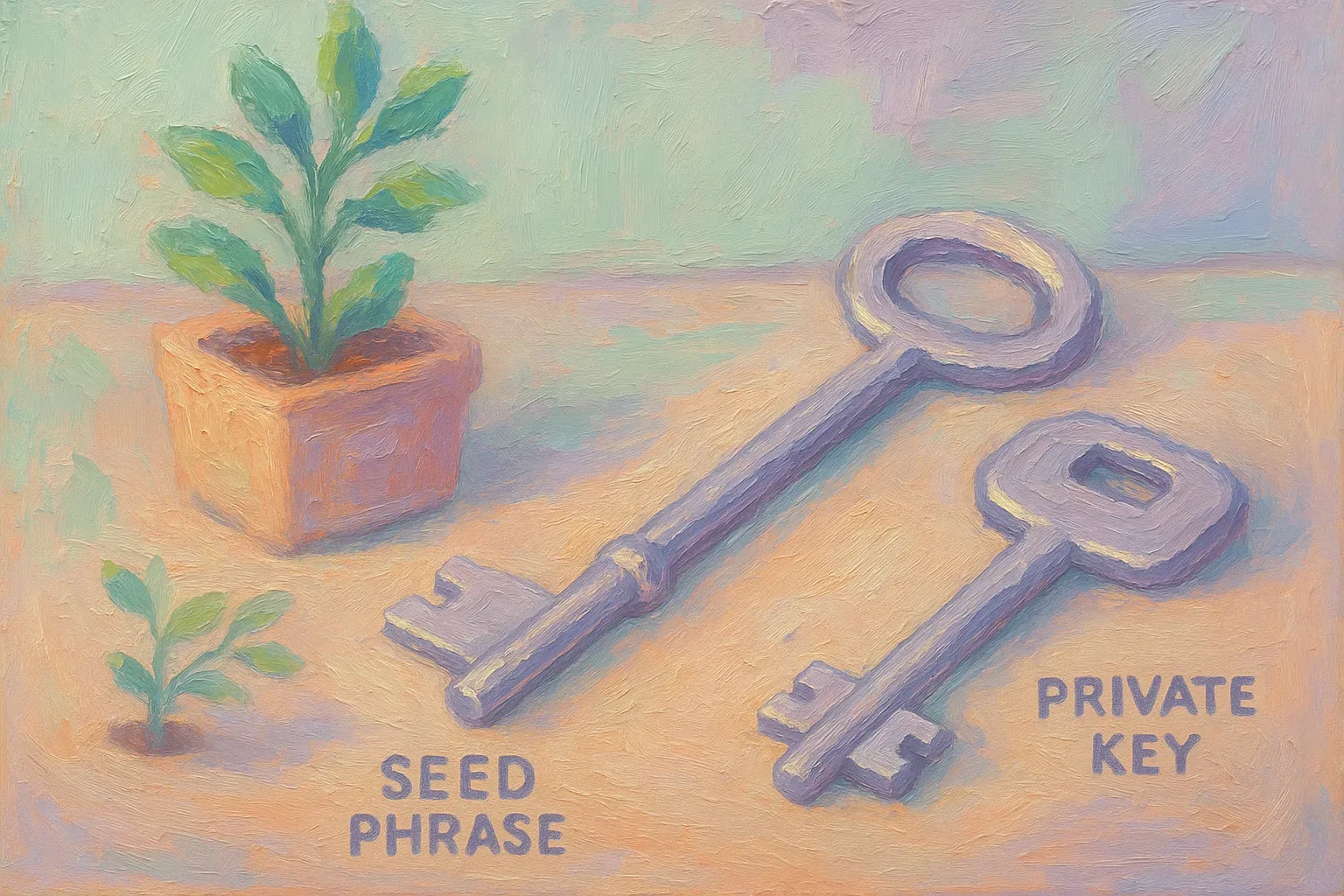
Introduction: Decoding Crypto Wallet Essentials
Among the most fundamental yet frequently confused concepts are the 'seed phrase' and the 'private key'. While both are critical to accessing and controlling your digital assets, their roles, structures, and security implications are distinctly different. By the end of this guide, you will possess the knowledge necessary for confident and secure cryptocurrency management, ensuring you understand the true power and responsibility that comes with self-custody.
Understanding the Seed Phrase: Your Master Key to Recovery
A seed phrase, often referred to as a mnemonic phrase or recovery phrase, is a sequence of typically 12 or 24 words, generated by your cryptocurrency wallet. These words are drawn from a standardized list (e.g., BIP-39) and arranged in a specific order. Think of it as the master key to a vault that contains all your digital assets, regardless of how many different cryptocurrencies or addresses you hold within that wallet. If your hardware wallet is lost or damaged, your software wallet app is deleted, or your computer crashes, your seed phrase is the only way to restore access to all the funds associated with that wallet on a new device. The seed phrase is the foundational element from which all other cryptographic keys in your wallet are deterministically derived. Losing it means losing access to your funds forever, and compromising it means an attacker gains control over all your assets. It represents the highest level of access and, therefore, the highest security priority.
What is a seed phrase and how does it function as the ultimate recovery mechanism for a crypto wallet?
A seed phrase is a human-readable sequence of words, usually 12 or 24, that acts as the master key to an entire cryptocurrency wallet. When a wallet is initially set up, it generates this unique seed phrase. This phrase is then used as the entropy (randomness) to deterministically derive a master private key, and subsequently, all individual private keys and public addresses associated with that wallet. If a user's wallet device is lost, stolen, or damaged, or if the wallet software is corrupted, the seed phrase allows the user to restore their entire wallet on a new device or software application. By entering the seed phrase, the new wallet software can recreate the exact same set of private keys and public addresses, thereby restoring access to all the funds.
Understanding the Private Key: The True Proof of Ownership
A private key is a secret, alphanumeric string of characters (typically 256 bits long) that directly corresponds to a single cryptocurrency public address. While a seed phrase is a master key for your entire wallet, a private key is the true cryptographic proof of ownership for the specific assets held at that single public address. It is the secret number that grants you the authority to spend the cryptocurrency associated with its corresponding public address. Every transaction you initiate from a crypto address must be cryptographically signed using its unique private key. This signature proves that the transaction was authorized by the legitimate owner of the funds, without revealing the private key itself. For instance, if you hold Bitcoin at a particular address, the private key linked to that address is the sole means by which you can move those specific Bitcoin. Unlike the seed phrase, which is designed for full wallet recovery, a private key grants immediate, direct control over only the funds associated with its specific public address. Because of this direct access, exposing a private key to anyone is akin to handing them your physical cash; they gain immediate and irreversible control over the funds at that address. Therefore, private keys must be kept absolutely secret and secure, as their compromise leads to the direct theft of the specific crypto assets they control.
What is a private key, and why is it the cryptographic proof of ownership for specific crypto assets?
A private key is a highly sensitive, cryptographic secret in the form of a long, random alphanumeric string. It serves as the direct and absolute proof of ownership for specific cryptocurrency assets held at a particular public address. When you want to send cryptocurrencies from a specific address, you must use its corresponding private key to cryptographically sign the transaction. This digital signature proves that you, and only you (the holder of the private key), have authorized the movement of those funds. Without the private key, you cannot spend or move the assets associated with that address.
The Hierarchical Connection: How Seed Phrases Generate Private Keys
The relationship between a seed phrase and private keys is hierarchical and deterministic, forming the backbone of what are known as Hierarchical Deterministic (HD) wallets. This system, predominantly defined by standards like BIP-32, BIP-39, and BIP-44, allows a single seed phrase to generate an entire tree-like structure of keys. The process begins with the seed phrase, which is first put through a cryptographic hashing function to create a master seed. From this master seed, a master private key is derived. This master private key can then generate an unlimited number of "child" private keys, each corresponding to a unique public address. If you import your seed phrase into a new wallet, it will reconstruct the entire wallet structure, including all your accounts, addresses, and the funds held within them. This hierarchical structure is precisely what allows a single, easily backup-able seed phrase to manage complex portfolios across multiple blockchains.
How does a seed phrase hierarchically generate multiple private keys, and what are the implications of this relationship?
A seed phrase hierarchically generates multiple private keys through a process defined by Hierarchical Deterministic (HD) wallet standards like BIP-32 and BIP-39. Initially, the seed phrase (a sequence of 12 or 24 words) is fed into a cryptographic function to produce a single, extended master private key. From this master private key, a deterministic algorithm can then generate an unlimited tree of child private keys and their corresponding public addresses. Each child key is unique but mathematically linked back to the master key, and ultimately, to the original seed phrase. Second, it enhances privacy by allowing a user to generate a new address for every transaction without the need to back up each new private key individually. Third, it consolidates security risk: while securing one seed phrase is easier than hundreds of private keys, a compromise of that single seed phrase means all assets across all addresses derived from it are vulnerable.
Side-By-Side: Key Differences Between Seed Phrases and Private Keys
To solidify understanding, a direct comparison highlighting the key differences between a seed phrase and a private key is essential. The most significant distinction lies in their scope and purpose. A seed phrase serves as the master key for an entire wallet, capable of regenerating all private keys and public addresses associated with it. Its format is typically a sequence of 12 or 24 human-readable words, designed for user friendly backup and recovery of the complete wallet. Its primary purpose is ultimate wallet recovery. It is an extremely long, complex alphanumeric string, not designed for human readability or direct backup, but for cryptographically signing individual transactions. Its primary purpose is to prove ownership and authorize spending for specific assets. Hierarchically, the seed phrase is at the top; it generates the private keys. A private key, on the other hand, is a derived component, a "child" of the seed phrase's structure. Protecting a single private key only secures the assets at that particular address. The compromise of a seed phrase leads to the loss of everything in the wallet, while the compromise of a private key leads to the loss of only the assets at its corresponding address. Recovery is also distinct: a seed phrase can restore an entire wallet, whereas a private key can only restore access to the funds at the specific address it controls, not the broader wallet structure or other addresses.
What are the direct functional and security differences between a seed phrase and a private key?
The direct functional and security differences between a seed phrase and a private key are fundamental. Functionally, a seed phrase serves as the ultimate recovery mechanism for an entire cryptocurrency wallet, allowing a user to restore access to all their accounts, addresses, and associated funds across potentially multiple cryptocurrencies. It is a human-readable sequence of words, designed for ease of backup and restoration of the complete wallet structure. A private key, by contrast, is a cryptographic string (often alphanumeric) directly linked to a single public address. Its function is to prove ownership of the funds at that specific address and to sign individual transactions, authorizing the spending of those particular assets. Security-wise, the seed phrase is a single point of failure for an entire wallet; if compromised, all funds across all addresses derived from it are at risk. A private key, while equally sensitive, pertains only to the assets at its corresponding address. Its compromise results in the loss of only those specific funds. The seed phrase is generative, producing all the private keys, while private keys are the generated entities that grant direct control over specific on-chain assets.
Why This Distinction Matters: Security, Management, and Best Practices
Firstly, from a security standpoint, recognizing that your seed phrase is the master key to all your assets across all addresses means its protection must be prioritized above all else. This understanding dictates best practices: your seed phrase should ideally be stored offline, perhaps etched into metal or written on high quality paper, and kept in multiple secure physical locations, never digitally or online. Secondly, effective management of your crypto portfolio hinges on this distinction. It is far more practical to back up and manage one seed phrase for an entire wallet, which can contain hundreds of different private keys and addresses, than to meticulously back up each individual private key. This hierarchical structure is a design choice to make self-custody manageable. Thirdly, when interacting with decentralized applications (dApps) or even sharing information, knowing which key does what prevents costly errors. You should never share your seed phrase with anyone, ever. While you might occasionally need to export a private key for a niche use case (e.g., to import an address into a specific application that doesn't support HD wallets), this action carries significant risk and should be done with extreme caution, understanding that you are exposing direct control over those funds. Grasping these differences empowers you to make informed decisions about how to store, back up, and interact with your digital wealth, forming the bedrock of robust self-custody practices. Neglecting this distinction is a common pitfall that exposes users to preventable vulnerabilities and potential financial ruin.
Why is understanding the distinction between these two concepts crucial for secure and effective cryptocurrency management?
A compromised seed phrase equals a complete loss of all digital assets managed by that wallet, whereas a compromised private key only exposes funds on a single address. This knowledge guides secure storage practices, advocating for offline, physical backup of the seed phrase, while private keys are typically managed by the wallet software. For effective management, the hierarchical relationship allows users to manage a vast number of addresses and assets with a single seed phrase backup, simplifying what would otherwise be an unmanageable task of backing up individual private keys. Without this clarity, users are prone to making critical errors that jeopardize their financial security in the crypto space.
Common Misconceptions and Frequently Asked Questions
Many users, particularly those new to cryptocurrency, hold several misconceptions regarding seed phrases and private keys. A common misunderstanding is that they are interchangeable or serve the exact same purpose. While both are critical for accessing funds, their scope and function are distinct, as elaborated previously. Another misconception is that you only need one or the other. In reality, a robust self-custody strategy relies on both: the seed phrase for overall wallet recovery and the underlying private keys (managed by your wallet) for spending individual assets. Some users also mistakenly believe that their wallet provider or exchange holds their seed phrase or private keys. For true self-custody wallets (non-custodial wallets), this is false; the user is solely responsible for generating, securing, and backing up these keys. Centralized exchanges, by definition, hold the private keys on your behalf. Confusing these leads to improper security practices.
Can a private key be used to recover a seed phrase, or vice-versa?
No, a private key cannot be used to recover a seed phrase. A private key is derived from the seed phrase in a hierarchical, one-way cryptographic process. You cannot take a single private key and backtrack to determine the original seed phrase. This is a fundamental security feature of HD wallets; if a single private key is exposed, it does not compromise the entire seed phrase and thus all other addresses in the wallet. However, the reverse is true: a seed phrase can absolutely be used to recover or regenerate all the private keys associated with a wallet. When you input a seed phrase into a compatible wallet, the wallet software uses it to deterministically derive the master private key and subsequently all the individual private keys and their corresponding public addresses.
Conclusion: Mastering Your Crypto's Foundation
The journey into confident cryptocurrency management begins with a clear understanding of its foundational elements. The distinction between a seed phrase and a private key, far from being a mere technicality, is the cornerstone of secure self-custody. We have definitively clarified that the seed phrase acts as the master recovery key for an entire wallet, enabling the regeneration of all assets and addresses. The private key, on the other hand, is the direct cryptographic proof of ownership for funds at a single public address, used for authorizing individual transactions. Their hierarchical relationship ensures that one seed phrase can efficiently manage a complex portfolio, while the security implications demand vigilant protection of both, with the seed phrase taking precedence due to its overarching control. By internalizing these distinct roles and the deterministic connection, you are empowered to implement robust security practices, mitigate common risks, and confidently navigate the decentralized landscape. Mastering these core concepts is not just about avoiding loss. It's about taking full, informed control of your digital financial future.